Bringing Back Sligo

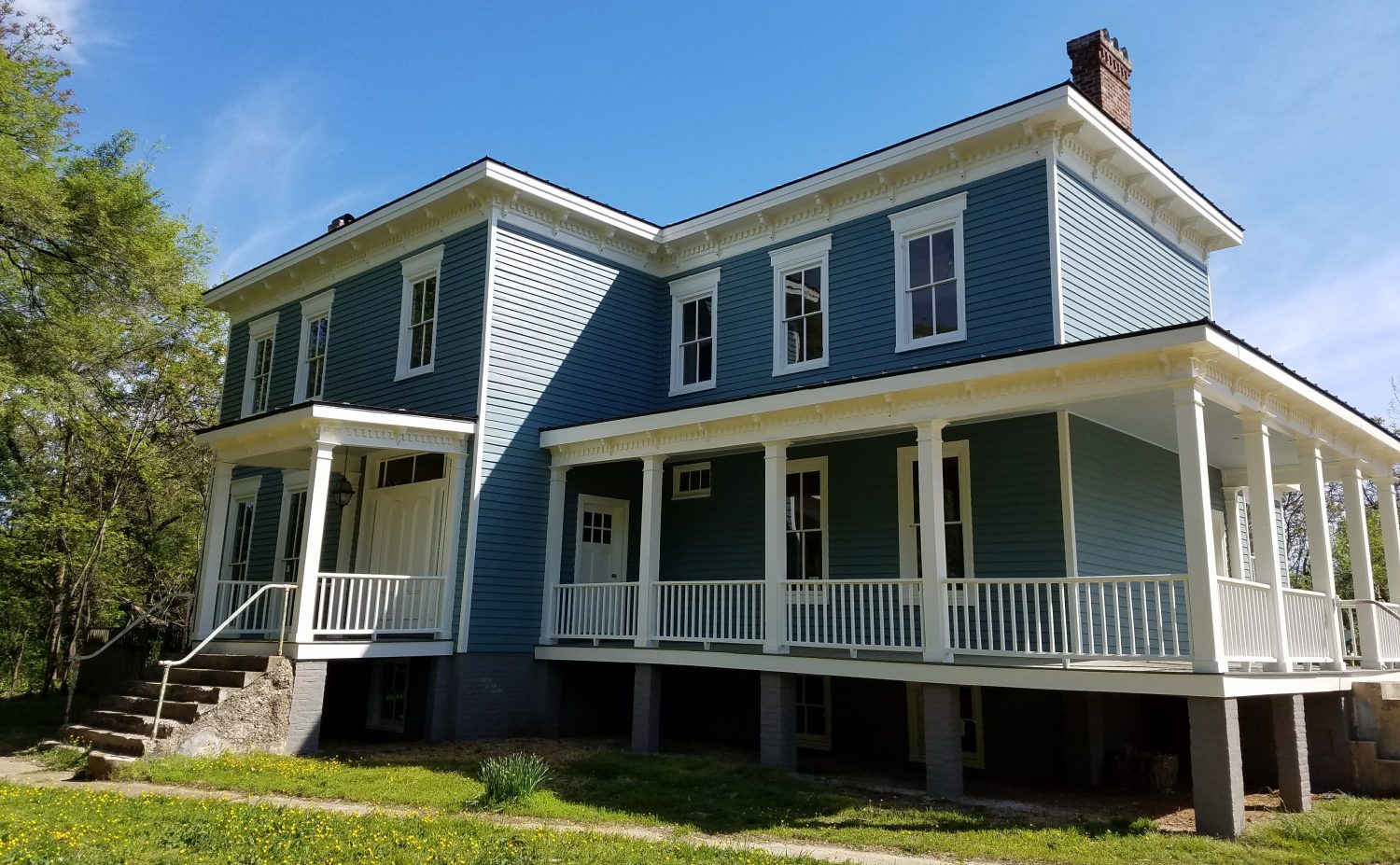
Breathing new life into an Italianate home in Fredericksburg, Virginia.
Bringing Back Sligo
  • Home
  • Archives
  • Contact
  • Category: Historic Registries

    • Rehabilitation Tax Credits

      Posted at 10:48 am by Lauren Tepaske, on April 27, 2021

      One of the biggest deciding factors for having Sligo listed as an historic property was to try and take advantage of the rehabilitation tax credits provided at both the state and national level. Considering the scope of work needed to make Sligo a livable space any little bit of reimbursement would be helpful in mitigating the costs. At the state level I believe the percentage is 25% of qualifying expenses and at the national level I believe the percentage is 20% of qualifying expenses. In a perfect world one could claim 45% total in tax credits but our world is far from perfect. The national tax credits can only be applied if the property is income producing so that makes it a little more complicated considering we have claimed the main floors of the house as our own, single-family dwelling (for now…more on that later).

      We knew enough to keep all of the receipts and invoices from the project which we did with a very systematic approach of stuffing everything into one folder. What I wish we knew, and I am certain Marcus would agree, is that we needed to keep every receipt and invoice along with how they were paid. So, for example, if we went to Lowes and purchased $2.00 worth of screws (and don’t go laughing at me because I’m ignorant to the price of screws and stupid, woman don’t you know screws cost at least double that this is just a hypothetical situation so calm down) we needed to be able to show from which account we purchased said $2.00 worth of screws. If you’re like Marcus and I, between the two of us, we have about six different accounts a purchase could have been made, including major credit cards. Keep reading and I’ll give you our social security numbers next!

      Marcus took on the task of sorting through the receipts, pulling account statements, and generating a massive Excel spreadsheet all while using what we fondly refer to as “Franken-computer” which is a laptop whose basic function now is merely for the computer itself while every other aspect has been outsourced with a separate monitor and keyboard. We have another laptop which is what I am currently using but it’s painfully slow. When it comes to electronics (and cars and phones) we are not up-to-date in the slightest. This is all to say that the task of sorting through 2 years of receipts and accounts was made all the more difficult by our current computer situation.

      Finally, after all of that, we Marcus has the spreadsheet ready to go to the accountant who, in this case, specializes in Virginia historic tax credits. We are hoping to get all of the state tax credits back and expect a portion of the national tax credits back for the basement which is a rental unit and therefore income producing. Which brings me to my “more on that later” comment which is this: Who wants to rent a three bedroom, roughly 3,000 square foot historic home for three years? Because *drumroll please* we are moving to Singapore!

      Posted in Historic Registries, Life, Main House, Uncategorized | 0 Comments
    • Virginia Historic Registry and the National Landmark Registry

      Posted at 8:15 pm by Lauren Tepaske, on August 6, 2020

      Y’all.  Why didn’t anyone tell me or remind me that I never wrote a post about Sligo being officially listed with the Virginia Landmarks Register (VLR) and the National Register of Historic Places (NRHP)?  I mean, it’s not like our dear, intrepid Dovetail consultant, Katie, didn’t work her butt off for over a year to get us there.  It’s not like it’s kind of a big deal…

      (Just to be clear, I am sure my take on the process varies wildly from the actual process.  I was more of an outsider offering my occasional insight to the history of the house as I knew it and had been passed on to me via the Ferneyhough descendants and others.)

      Almost from the beginning (Julyish 2018) Marcus and I started considering the possiblity of getting Sligo on the respective registries.  I think it came about mostly because Marcus learned we could apply for tax credits (I mean, is anyone surprised by the fact Marcus was looking for ways to make this a more profitable endeavor?).  The scope of work required seemed totally do-able at first.  I filled out the Preliminary Information Form (PIF) to the best of my knowledge and submitted it to the Department of Historic Resources (DHR).  Surprisingly, and despite the fact I used only the Works Progress Administration (WPA) report (I wrote a post a while back but for a brief synopsis just know they aren’t entirely accurate) as a source of information, it was accepted because the house was deemed eligible for its architecture.  However, the DHR was most interested in learning the exact build date and the architect.  How hard could that be?  It’s not like in the late 19th century there wasn’t documentation and permits issued and a city department in charge of planning that would have housed all of this information (there wasn’t).

      I like to think I made a fairly decent attempt at researching the house and when exactly it was built (though to this day the architect is unknown).  My mom and I found ourselves driving between both the Fredericksburg and Spotsylvania courthouses working through their respective archives (remember that Sligo was annexed from the county of Spotsylvania into the city of Fredericksburg in 1955).  To do this we had to start at the most recent owners (ourselves) and work our way back.  Eventually, it was at the Spotsylvania courthouse that we found what we had been looking for:

      Deed Book CC, Page 53, January 18, 1889 between George Ferneyhough & Lavinia and G.W. Wallace (trustee), containing 42 acres more or less, secure payment of farm bonds of even date with this deed each for the sum of $375.00 paid in 2, 3, 4, 5 years respectively…and it is covenanted and agreed between the parties aforesaid that the said Geo. T. Ferneyhough will keep the dwelling on said farm now being erected insured for not less than $1,000 in case of a sale being necessary by reason of default.  (So, basically, huzzah!  We had a build date of 1889!)

      After this exciting discovery I turned my attention to filling out the second part of the paperwork required by DHR.  Looking back, I have an email forwarded from the DHR outlining the requirements and Marcus simply stating in his message “Up to the challenge?” and the answer was “no.”  No, I was not up to the challenge.  On more than one occasion during the early days of asking around about the house I was told about Dovetail Cultural Resource Group, a woman-owned, small business in Fredericksburg whose services include “National, State, and Local Register Designations.”  Me, being a woman, and Marcus, being the progressive and supportive guy that he is, thought it would be well worth it to contact them and inquire about their services.

      And so, that was how it came to be that sometime in December 2018, Katie at Dovetail began working on Sligo’s nomination.  The nomination included details about the interior and exterior architecture using vernacular that escapes me (an example being “two over two double hung” and which describes the window and the number of panes…I think).  Along with the descriptive narrative pertaining to the architecture there is an historical narrative that requires a significant amount of research which Katie undoubtedly had much better insight for where to look and how.  Finally, there is an analysis of other similarly constructed buildings in the area (of which there are few Italianate style homes like Sligo in the city) rounding out the nomination.

      Once the nomination was submitted in June 2019 we had to wait for the DHR to meet in September to review the submission.  Once they approved the nomination in September it was then sent to the National Park Service who approved Sligo’s nomination for the NRHP in November of 2019.  And that, as they say, is history!  Ha!  Please don’t unfollow me.

      If you are interested in reading the actual nomination form follow this link which will direct you to a PDF version:  https://www.dhr.virginia.gov/historic-registers/111-0097/

      From what I can tell Sligo does not have any files scanned into the NRHP’s website so you can look for it but the information is minimal.  You will gain more from the DHR link above.


      Posted in Historic Registries, History, Life, Main House | 0 Comments
    • Recent Posts

      • Preoccupied December 20, 2021
      • The “Haunting” of Sligo August 4, 2021
      • Rehabilitation Tax Credits April 27, 2021
      • Put Me in Blogger Jail April 6, 2021
      • Virginia Historic Registry and the National Landmark Registry August 6, 2020
      • My Good Boy, Axel July 14, 2020
    • Follow Us

      • Facebook
      • Instagram
      • X
      • Pinterest
    • Search

  • Enter your email address to follow this blog and receive notifications of new posts by email.

    Join 531 other subscribers
  • Follow Bringing Back Sligo on WordPress.com
  • Bringing Back Sligo

    Bringing Back Sligo
  • Copyright 2019
    Lauren Tepaske
    All Rights Reserved

Create a website or blog at WordPress.com

  • Subscribe Subscribed
    • Bringing Back Sligo
    • Join 86 other subscribers
    • Already have a WordPress.com account? Log in now.
    • Bringing Back Sligo
    • Subscribe Subscribed
    • Sign up
    • Log in
    • Report this content
    • View site in Reader
    • Manage subscriptions
    • Collapse this bar